AllOnGeorgia filed an Open Records Request with the Chattooga County Sheriff’s Office. We asked how many Flock cameras the county has, where they are, who approved them, what they cost, how long the county keeps the data, who can access it, and how often it’s actually used.

Those questions matter because of what’s been happening all over the country. Law enforcement officers across the country are facing discipline and criminal charges over misuse of Flock Safety license plate reader (LPR) cameras. In Texas, an officer is facing charges for searching his ex-girlfriend’s plate more than 10,000 times. In Florida, Governor Ron DeSantis has ordered flock cameras pulled off state highways within 30 days. “If you want to get in your car and you want to go down to Buc-ee’s in St. Augustine, it’s really none of the government’s damn business if you’re doing that, right?” DeSantis said.
It’s happening right next door, too. Just this week, Hamilton County, Tennessee Sheriff Austin Garrett announced he’s pausing all LPR programs. Sullivan County, Tennessee suspended its Flock cameras a few weeks earlier.
And it’s happening in Georgia too. Two dozen law enforcement officers in Georgia have faced discipline and criminal charges for misusing Flock data.
The country needs to find a “compromise” between privacy and safety, according to Flock Safety CEO Garrett Langley. “When people talk about just one of these, privacy or safety, they’re prioritizing the wrong thing, and what we have to prioritize as a country is compromise,” Langley said during a recent interview. “How do we have our safety, and how do we balance privacy?”
So, what does that compromise actually look like here in Chattooga County? And what information did Chattooga County Sheriff Mark Schrader provide regarding Flock cameras?
How Many Do We Have, and Where?
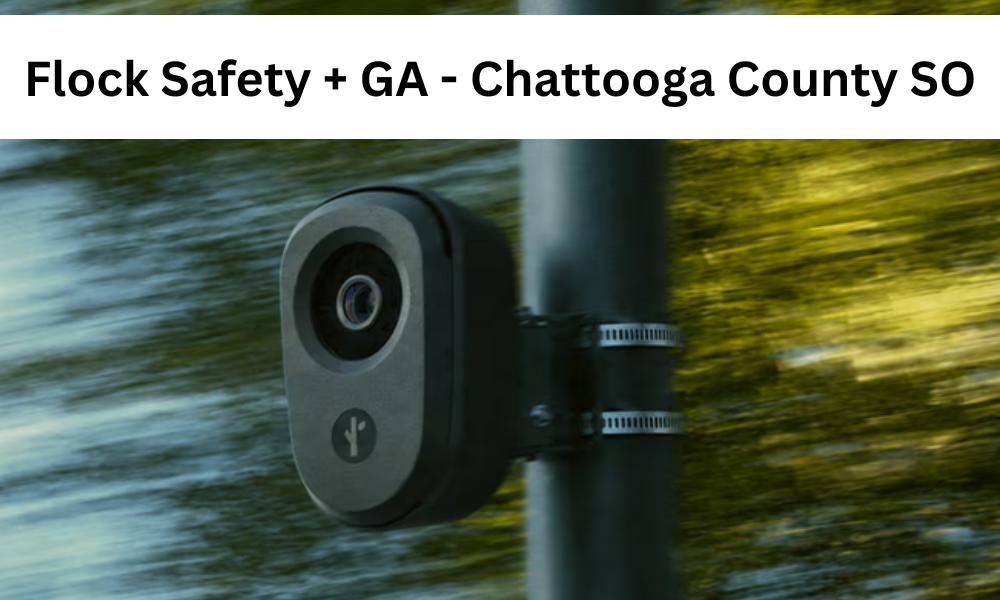
The Chattooga Sheriff’s Office directly operates two LPR cameras:
- GA 48 at Gadsden Avenue, went live August 13, 2026
- GA 48 at James Street, went live July 14, 2026
There are also two additional cameras on Highway 27 that the Sheriff’s Office did not install and does not own. Those were installed by the Georgia Department of Corrections near Hays State Prison a couple of years ago to help stop contraband from reaching state prisons. The Sheriff’s Office was later given access to that camera data, though it doesn’t have installation details on those two specifically.
What Do They Actually Do?
According to Sheriff Mark Schrader, these are strictly LPR, or license plate reader, cameras. They read plates only. They do not record live video, audio, or have pan, tilt, or zoom capability, and they don’t pull registered owner information. Each camera checks a plate against GCIC and NCIC, Georgia and national crime databases, and only generates an alert if that plate is flagged, such as for a stolen vehicle, a wanted or missing person, or a sex offender registry entry. Deputies can also search by make, model, and color when a plate number isn’t available.
What Does the Written Policy Say?
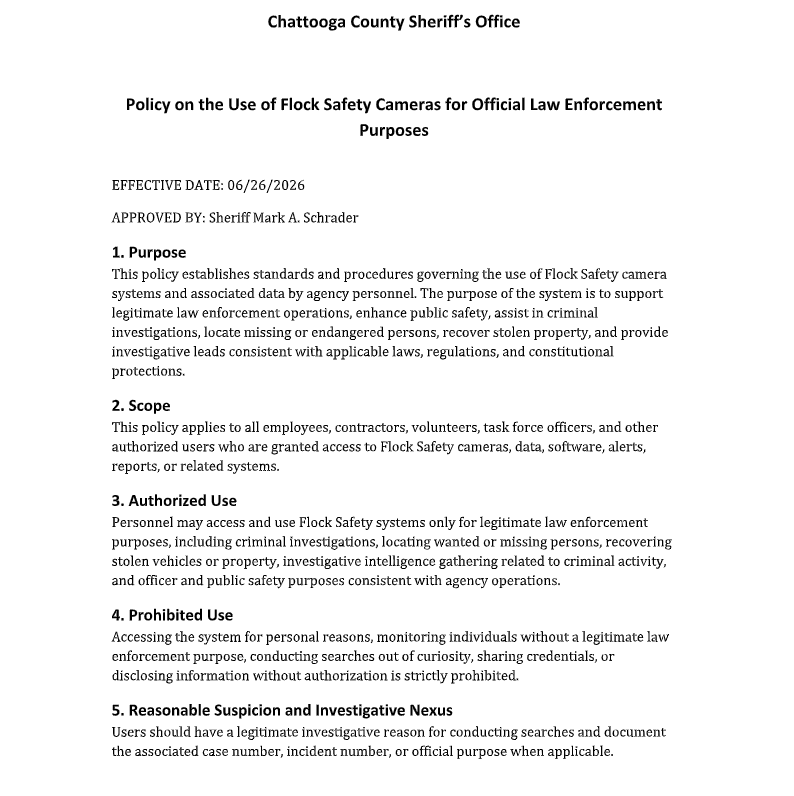
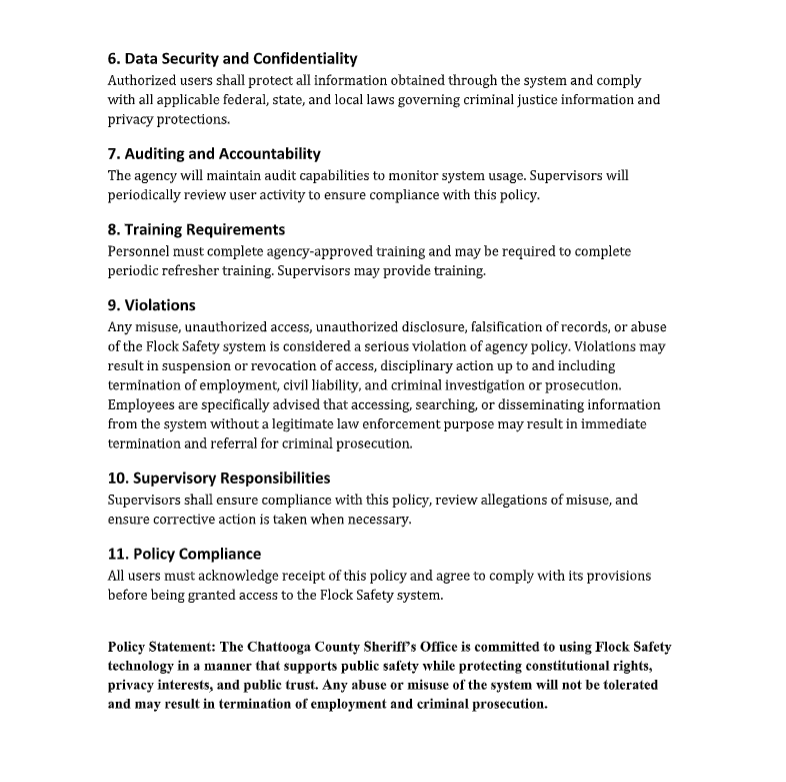
Chattooga County Sheriff’s Office Policy Chapter 22.1, effective June 26, 2026, and approved directly by Sheriff Schrader, governs the system. It establishes standards for the use of Flock Safety cameras and data, limits access to legitimate law enforcement purposes, including criminal investigations, locating missing or wanted persons, recovering stolen property, and officer or public safety, and explicitly prohibits accessing the system for personal reasons, curiosity, or unauthorized disclosure.
The policy requires users to document a case number, incident number, or official purpose for searches, and mandates ongoing auditing of user activity by supervisors. Personnel must complete approved training before being granted access. Violations, including unauthorized access, disclosure, or falsification of records, can result in suspension or revocation of access, termination, civil liability, and criminal prosecution.
How Do They Search Them?
Access isn’t automatic just because someone works at the department. All patrol deputies can receive passive alerts, including stolen vehicle, missing person, wanted person, and similar categories. But an actual search of a specific plate or vehicle has to go through a supervisor or investigator, who runs it only after the deputy provides a case number, dispatch CAD number, or documented reason.
Eighteen people currently have access to the system.
We reached out to Sheriff Schrader directly to ask him to walk through how the system has actually been used locally, and what he’d say to residents concerned about misuse elsewhere in the country. Here’s what he told us:
“I learned, firsthand, of the benefit of LPR technology when we had the triple homicide on Hwy 100 shortly after I took office. After our suspect was identified and the vehicle he was in was entered into NCIC/GCIC he was arrested the next day. His arrest in Coweta County, Georgia was a result of LPR technology.”
Schrader also pointed to the cameras installed by the Georgia Department of Corrections near Hays State Prison, which his office was later given access to for official law enforcement use: “As a result of the alerts from those cameras, my office has recovered two different dementia patients that had left Alabama traveling in an unknown direction. By the Alabama agency entering those plate numbers we were able to be notified when they came through Chattooga County. Both were successfully re-united with family.”
He described one recovery he responded to personally: “I was sitting at my desk and received an alert for a stolen vehicle that was traveling north past Tractor Supply. I went out to my vehicle and was able to catch up to the vehicle above Trion. I verified the stolen status through our 911 center and confirmed that it was reported stolen through Walker County. I initiated the traffic stop and the vehicle was recovered and the driver was arrested.”
On the misuse cases making national headlines, Schrader said he understands the concern but wanted to clarify what the technology in Chattooga County can and can’t do: “With the multiple reports of abuse utilizing these systems, as well as some misinformation concerning the capabilities of LPR cameras, I certainly understand the concern of the public. I want to clarify that the cameras utilized within Chattooga County are LPR readers only and not cameras that detect faces, phones, audio or have the ability to utilize pan, tilt or zoom features. Those cameras may be available out there somewhere, but those are not being used here.”
He also walked through the search process in his own words: “Currently the way our system is set up is that a deputy can request a specific plate be searched by providing their supervisor with the required information. That information includes the case number of the current case that they are working related to the plate and the reason why they need it searched. A supervisor or investigator can then perform the search and provide the information to the deputy… If a specific plate receives a ‘hit’ the deputy must still verify that the ‘hit’ is the correct information and run that plate through 911 to verify the status as either stolen, wanted person, etc. before taking action. All searches are subject to auditing by policy.”
How Often Is It Actually Used?
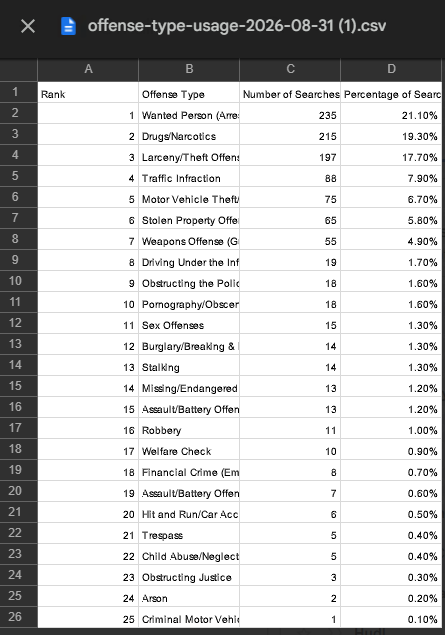
Between January 1 and August 31, 2026, the system logged 1,112 searches locally. The top reasons: wanted person/fugitive (235, 21.1%); drugs/narcotics (215, 19.3%); larceny/theft (197, 17.7%); traffic infraction (88, 7.9%); and stolen vehicle (75, 6.7%). Smaller categories include missing persons (13), domestic assault (7), and stalking (14).
How Much Does It Cost, and Who’s Paying?
The contract is with Flock Group Inc., signed November 21, 2025 by Sheriff Schrader for the county and Flock’s Chief Legal Officer Dan Haley. It’s a 24-month initial term that auto-renews annually unless either side gives 30 days’ notice before the term ends. Payment terms are Net 30, billed annually, with the first year invoiced at signing.
Year 1 total: $7,300, including a $1,300 one-time implementation fee for setup, testing, and shipping. Every year after: $6,000 per year recurring. Contract total over the initial 24-month term: $13,300.
According to the Sheriff, these cameras were not funded with general tax revenue. They were paid for using asset forfeiture funds.
Where’s the Data Stored, and for How Long?
Data sits in Flock’s cloud storage, which the Sheriff’s Office says is required to comply with CJIS (Criminal Justice Information Services) standards. Nothing is kept past 30 days unless it’s downloaded into an active case file, a retention window that’s also written directly into the contract itself.
Where That Leaves It
Two cameras. $13,300 over two years, paid through asset forfeiture rather than taxes. 1,112 searches in eight months, the vast majority tied to wanted persons, drugs, and theft. A written policy that requires a documented reason for every search, subject to audit. Eighteen people have the keys to it.
Whether that’s the right balance between privacy and public safety, the same balance Langley says the country needs to strike, is something readers can weigh for themselves.
The country has changed a lot in the nearly 250 years since Benjamin Franklin warned against trading liberty for safety, and the Fourth Amendment’s protection against unreasonable searches has been tested by technology no one in Franklin’s era could have imagined. License plate readers are just the latest version of that same old question: how much are we willing to let the government watch, in exchange for how much safety it promises in return?
“Those who would give up essential Liberty, to purchase a little temporary Safety, deserve neither Liberty nor Safety.”




Chattooga Local News
What The Flock Is Going On?

Bulloch Public Safety
09/02/2026 Booking Report for Bulloch County

Chattooga Local News
Tennessee Pledges Full State Funding for Dolly Parton’s Imagination Library

Chattooga Local News
State Audit Proves Georgia is National Leader in Clean Voter Lists

Bulloch Public Safety
08/31/2026 Booking Report for Bulloch County
Bulloch Public Safety
08/24/2026 Booking Report for Bulloch County
Bulloch Public Safety
08/10/2026 Booking Report for Bulloch County
Bulloch Public Safety
08/12/2026 Booking Report for Bulloch County
Bulloch Public Safety
08/21/2026 Booking Report for Bulloch County