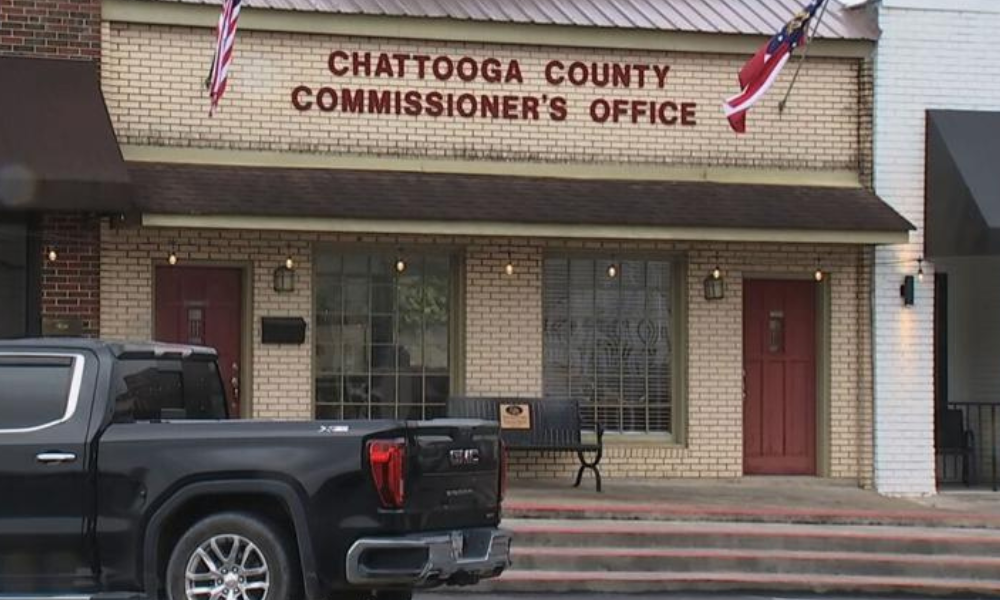
Chattooga County has fallen behind on its state-mandated financial audits for at least three years running, and the county’s most recent audit is now formally listed as “Delinquent” by the Georgia Department of Audits — meaning the report has not been received at all, months after it was due.

Under Georgia law, local governments must submit their annual audited financial statements within 180 days of the close of their fiscal year. For Chattooga County, whose fiscal year ends December 31, that puts the statutory deadline each year at June 30 of the following year.
According to the state’s compliance tracking, the county has missed that deadline in four of the last six reporting years:
- 2020 (due 6/30/2021): Submitted on time, under an extension to 9/30/2021
- 2021 (due 6/30/2022): Submitted on time, under an extension to 12/31/2022
- 2022 (due 6/30/2023): Late — no extension on file
- 2023 (due 6/30/2024): Late, even after an extension to 12/31/2024
- 2024 (due 6/30/2025): Late, even after an extension to 12/31/2025 — the audit report was not actually signed and issued until May 15, 2026, nearly five months past the extended deadline and almost a full year past the original one
- 2025 (due 6/30/2026): Currently marked Delinquent, with the state noting the report has not been received
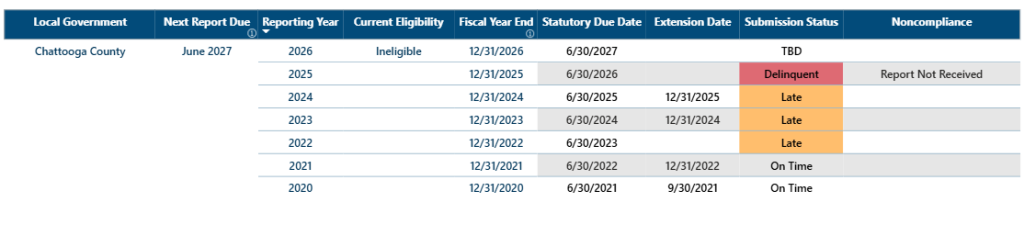
The county’s 2026 reporting year is listed as “ineligible” for the standard track, with a next report due date of June 2027.
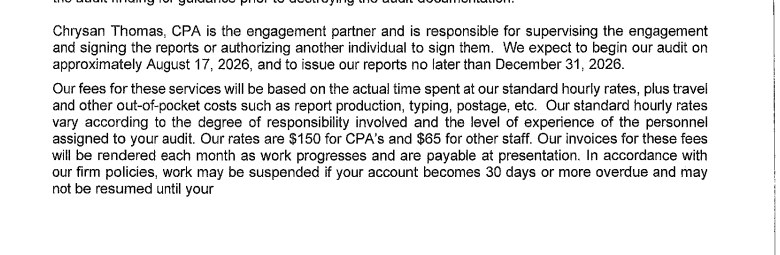
The county’s own records also show that fieldwork on the 2025 audit — the one currently listed as delinquent — was not even scheduled to begin until August 17, 2026, per the county’s engagement letter with its auditor. That start date falls nearly seven weeks after the statutory deadline had already passed, and the engagement letter sets a target of no later than December 31, 2026, for the audit report to be issued. If that timeline holds, the county will have gone roughly six months past its original due date before the 2025 audit is complete.
What the Audit Costs
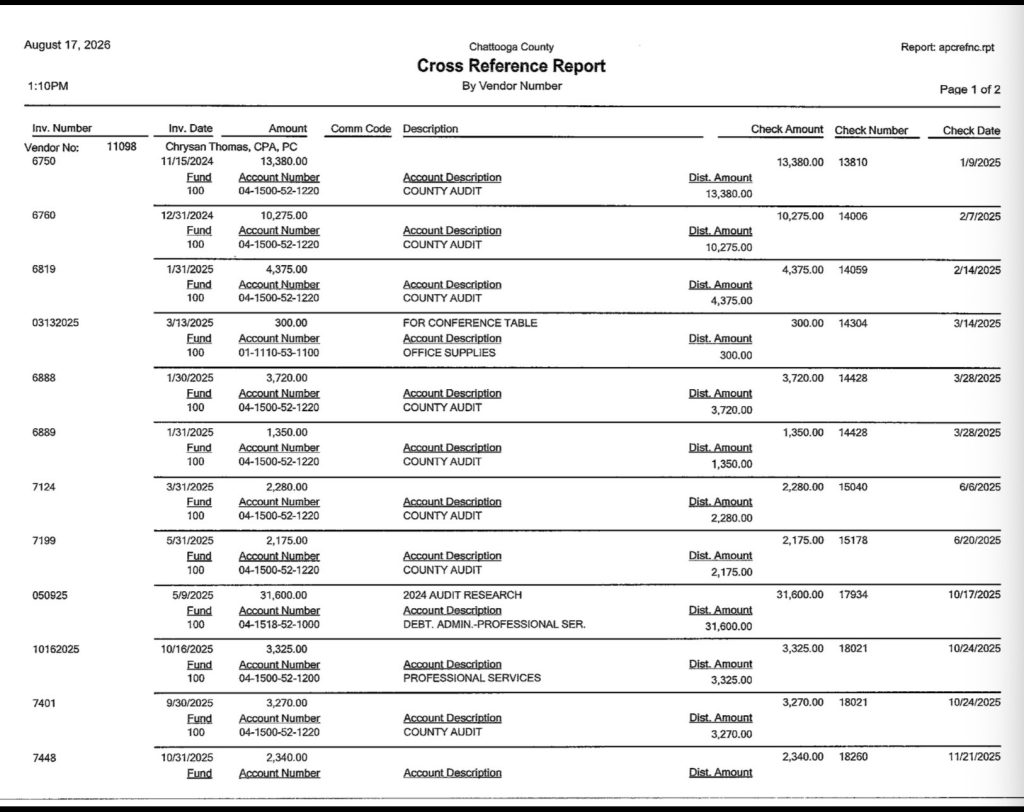
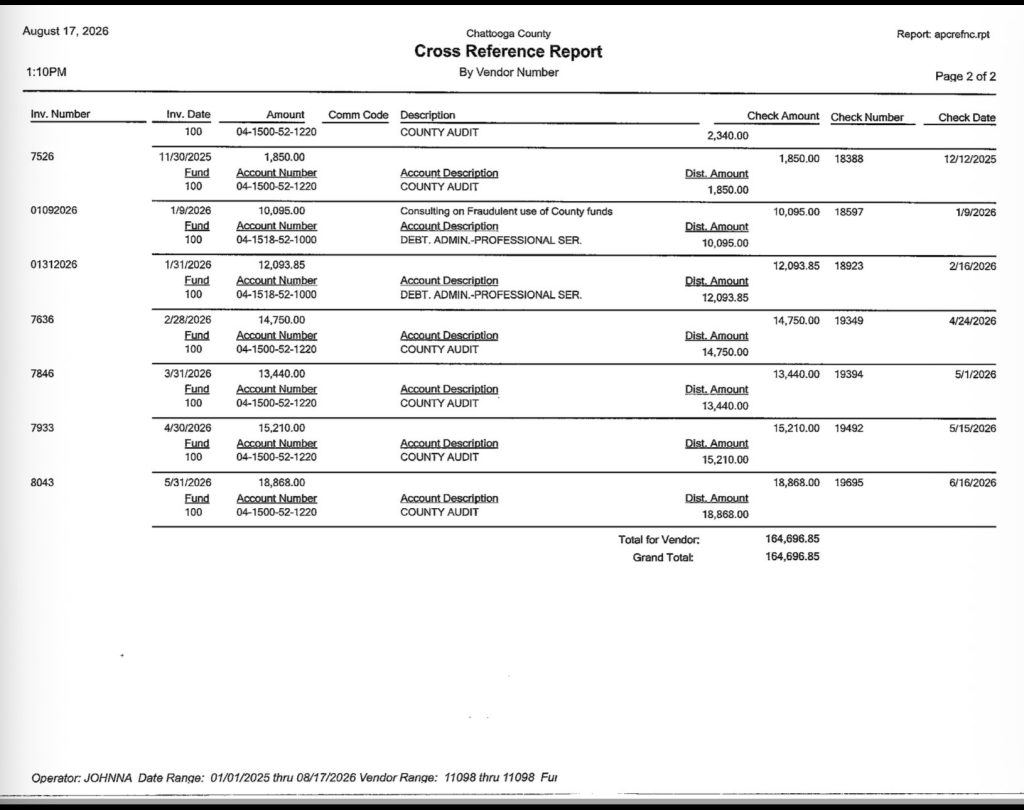
The county’s outside auditor, Chrysan Thomas, CPA, a professional corporation based in Trion, has been paid $123,001.85 for audit services between January 2025 and June 2026, according to county accounts payable records, with the bulk of the payments coded to the county’s standard “County Audit” line item.
Separately, the same vendor number received two additional payments totaling $41,695, coded not to the audit line but to “Debt Administration – Professional Services”:
- A $31,600 payment on May 9, 2025, described as “2024 Audit Research.”
- A $10,095 payment on January 9, 2026, described as “Consulting on Fraudulent use of County funds.”
In a May 6, 2026 email to AllOnGeorgia, Commissioner Andy Allen said the 2025 audit “will start right after the completion of 2024” and that the county expected “to submit our 2025 by the end of June, and we won’t have any gaps in grant funding.” Allen’s email came the day after auditors were expected to submit the finished 2024 write-ups — meaning his stated timeline had 2025 fieldwork beginning within days of the 2024 audit wrapping up.
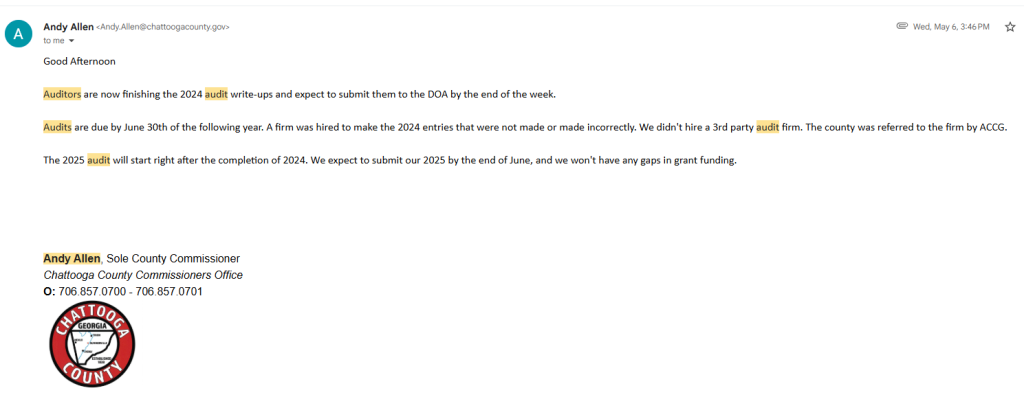
That timeline does not match the county’s own engagement letter for the 2025 audit, which sets fieldwork to begin August 17, 2026 — more than three months after the 2024 report was actually issued — and sets a report deadline of no later than December 31, 2026, not the end of June as Allen stated.
By July 2, 2026 — after the end-of-June date Allen had cited in May had come and gone without the 2025 audit being submitted — Allen offered a new explanation in a follow-up email to AllOnGeorgia. He said the 2025 audit “has been delayed due to over 100 corrections and entries that staff had to make to get it started,” and that auditors were “working as fast as they can to complete 2025.” He did not repeat the end-of-June submission date or offer a new one, saying only that the county hoped to have the audit “complete and submitted soon.” He added, “We don’t anticipate any delays in grant funding.”
Between the two emails, the county’s explanation and timeline for the 2025 audit shifted. The county’s engagement letter, meanwhile, does not have fieldwork starting until August 17, 2026.
In his May 6 email, Allen also addressed the Debt Administration charges tied to the county’s correction of its 2024 books. He said the county did not hire a third-party audit firm for that work, but rather a firm referred by the Association County Commissioners of Georgia (ACCG) to make 2024 entries that “were not made or made incorrectly.” County accounts payable records show the two payments for that work — $31,600 on May 9, 2025, and $10,095 on January 9, 2026 — were made under the same vendor number as Chrysan Thomas, CPA, though coded to a different account than the standard audit line.
A $300 charge in March 2025, coded to a general office-supplies account for a conference table, was also run through the same vendor.
What the FY2024 Audit Found
The audit that was eventually completed for fiscal year 2024 was not a clean one. The independent auditor identified three material weaknesses and two significant deficiencies in the county’s internal controls, along with one instance of noncompliance serious enough to require reporting under federal Government Auditing Standards.
Among the findings:
- The county lacked sufficient staff to reconcile bank accounts or general ledger balances in a timely manner; some bank accounts were not reflected in the general ledger at all.
- A broadband internet project funded through American Rescue Plan Act (ARPA) money showed inadequate documentation, insufficient oversight, and noncompliance with procurement rules. The county paid $333,265 to a vendor without sufficient evidence the work was performed, plus $29,607 in sales tax the county should not have had to pay as a tax-exempt government entity. The county has since won a civil judgment against the vendor but had not recovered any of the money as of the date of the audit report.
- Similar documentation and procurement problems were found in road-paving projects funded by state grant programs, with payments exceeding approved bid amounts by more than $180,000 combined across two programs, and no documentation on file explaining the overages.
- A sealed-bid purchase of a 2020 Polaris Ranger went to a vendor identified as a related party, at a bid roughly $10,600 higher than a competing bid, with no documented justification beyond an unsigned statement citing the vehicle’s “pristine condition.”
- The county was found to have inadequate segregation of duties across its accounting functions, increasing the risk that errors or misappropriation of funds could go undetected.
- Several county departments spent beyond their approved budgets without the county formally amending those budgets during the year, as required under state law.
County management responded to each finding by acknowledging the issues and stating that new accounting staff had been hired and that additional oversight, training, and documentation procedures were being put in place going forward. Despite those assurances, the county is once again late — this time delinquent on the very next year’s audit.
Chattooga is one of only 18 of Georgia’s 159 counties currently listed as “ineligible” by the Department of Audits, according to the agency’s own tracking data. The remaining 141 counties, or 89 percent, are listed as eligible. Per the Department’s own definition, local governments are eligible to receive state grant funds only when they have complied with all applicable audit report and grant certification requirements — meaning Chattooga’s delinquent status carries a direct, practical consequence: the county is currently ineligible for state grant funding until its audit is brought current.
What It Means
Georgia’s 180-day audit deadline exists to give the state, local taxpayers, and anyone doing business with the county a reasonably current picture of its finances. A pattern of late and now delinquent filings means that picture has been out of date for years at a time — the public did not see verified financial statements for fiscal year 2024 until May 2026, and as of this writing, there is still no completed audit on file for fiscal year 2025.
Combined with the internal control weaknesses identified in the most recent completed audit — including the unresolved $333,265 broadband payment and the unexplained overages on state-funded road projects — the delinquent filing raises questions about how closely the county’s finances are being tracked in real time, not just after the fact.
AllOnGeorgia did request a response addressing the following questions regarding the outstanding FY2025 audit, to the extent Sole Commissioner Andy Allen or County Clerk Johnna Allen could provide this information:
County Clerk Johnna Allen responded:
-
What specific challenges or complexities have contributed to the delay in completing the FY2025 audit? J Allen: FY2024 audit had to be completed, submitted and accepted before FY2025 audit could be completed.
-
Does the county’s finance/accounting staff have adequate capacity and governmental accounting experience to support timely completion of the audit? J. Allen: yes
-
What specific information, documentation, or reports (and from which department) remain outstanding and are needed to complete the audit? J. Allen: All information has been provided to the auditors, and they are working diligently to complete FY2025 audit.
-
Does the fact that the FY2025 audit remains outstanding create any complications for the county’s process for setting the millage rate? J. Allen: no
-
Do you think HB 244 will help Chattooga County get future audits submitted on time? J. Allen: No, current budgeted expenses exceed the $2.5M threshold and a full audit will still be required. *Editor’s note: The new law gives qualifying local governments the option to file under a regulatory basis reporting method in lieu of a full GAAP audit, raises the threshold for agreed-upon procedures reports, and *establishes a new 90-day audit filing extension option with accountability provisions for local officials who fail to submit required documentation on time.*




Chattooga Local News
Floyd County Commission Approves Data Center Ordinance

Bulloch Public Safety
08/26/2026 Booking Report for Bulloch County

Bulloch Public Safety
Azul Restaurant Homicide Suspect Arrested in Statesboro
Bulloch Public Safety
08/24/2026 Booking Report for Bulloch County
Bulloch Public Safety
08/10/2026 Booking Report for Bulloch County
Bulloch Public Safety
08/12/2026 Booking Report for Bulloch County
Bulloch Public Safety
08/21/2026 Booking Report for Bulloch County
Bulloch Public Safety
08/07/2026 Booking Report for Bulloch County