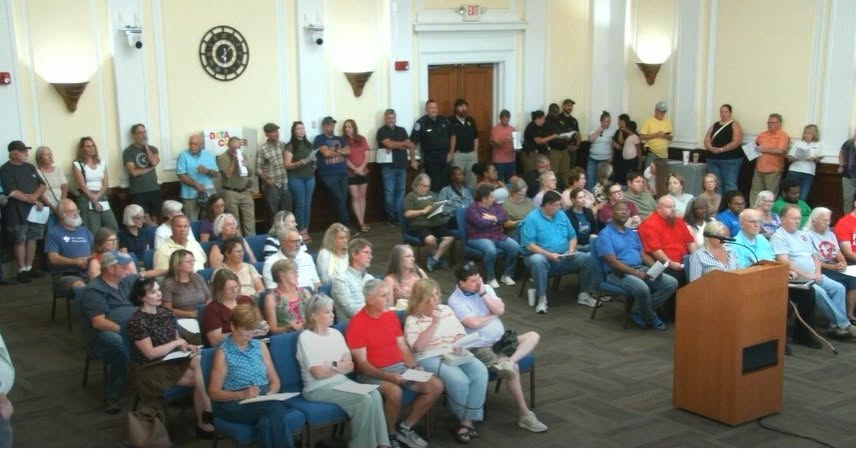
The Floyd County Board of Commissioners approved an ordinance establishing zoning and development standards for any future data center proposals in unincorporated Floyd County.
The ordinance provides Floyd County with a comprehensive framework for evaluating data center proposals and ensuring that developers remain responsible for their projects throughout the facilities’ operating lives and after they close.
Under the ordinance, data centers are permitted only within the Heavy Industrial zoning district. Proposed facilities must satisfy detailed requirements addressing noise, utility capacity, water consumption, environmental effects, emergency preparedness, neighborhood compatibility and the eventual restoration of project sites.
The ordinance is intended to address concerns residents commonly raise about large data center projects while establishing clear expectations that developers must meet before permits can be issued.
Utility capacity must be demonstrated
Before any permits can be issued, developers must submit a power, water and broadband internet impact study. The study must identify the project’s expected demand at full development, proposed construction phases and any off-site improvements necessary to serve the facility.
No permits can be issued until affected utility providers confirm in writing that adequate electricity, water, sewer and natural-gas capacity will be available when the project is completed.
Developers must enter into binding agreements with utility providers to fund and complete necessary extensions or infrastructure improvements. Those agreements must include monitoring, reporting and enforcement provisions.
Facilities expected to use more than 10 megawatts of electricity must also submit an energy and sustainability plan explaining how the operator will improve energy efficiency, reduce carbon intensity and limit environmental effects.
Water-use restrictions
The ordinance prioritizes closed-loop cooling systems, which reuse water instead of continuously drawing a new supply.
A data center proposing water-cooled equipment must install a water reclamation and reuse system. The developer must also demonstrate that the proposed cooling system represents the least water-intensive technology feasible for the site.
Facilities must comply with the water-use limits and efficiency requirements established by the applicable utility provider.
The ordinance prohibits data centers from using private wells, private septic systems, direct surface-water withdrawals or direct connections to aquifers. All facilities must use public sewer service.
Noise limits and property setbacks
Every data center applicant must complete an acoustic study assessing the noise expected from cooling equipment, facility operations, backup generators and other equipment.
Sound-reducing walls are required around outdoor generator areas, and additional noise-control measures may be required for the primary data center buildings.
When a facility adjoins residentially zoned property, noise measured at the property line cannot exceed: 65 dB(A) between 7 a.m. and 11 p.m. and 55 dB(A) between 11 p.m. and 7 a.m. The property-line limit next to other zoning districts is 70 dB(A).
For general reference, federal hearing-health resources typically place a whisper near 30 dB(A) and normal conversation between approximately 60 and 70 dB(A). These comparisons are approximate because perceived noise varies depending on distance, duration, surroundings and the type of sound being produced.
Primary data center buildings must use sound-reducing construction materials. Metal-panel construction is permitted only when an acoustic analysis demonstrates that the building can comply with the County’s property-line noise limits.
Data center buildings must remain at least 600 feet from an existing residence. A 300-foot setback and landscaped buffer are required next to residentially or agriculturally zoned property. Additional setback requirements apply near commercial and industrial properties.
Generators and related equipment are also subject to residential setback requirements and must be screened with evergreen vegetation.
Environmental and neighborhood protections
Outdoor lighting must be compatible with dark-sky standards and designed to limit light spilling across property lines.
Security fencing visible from public areas cannot consist of chain link, barbed wire, razor wire or solid metal panels. Landscaping, decorative fencing or other approved materials must be used to reduce the facility’s visual impact from public roads.
Backup generators are generally limited to emergency operation, required testing and commissioning activities. Generators must also comply with applicable performance and emission-control standards.
Before receiving a Certificate of Occupancy, each facility must prepare an emergency response plan in coordination with local fire and emergency services. Appropriate fire-suppression systems are required, and operators may be required to participate in emergency drills with local agencies.
Developers are responsible for cleanup and restoration
Before permits are issued, developers must submit a decommissioning plan explaining how the property will be restored when the facility closes.
The plan must address:
- Removal of equipment and structures
- Safe disposal of hazardous materials
- Testing of soil and groundwater
- Cleanup of contamination
- Restoration of the property
Developers must provide a bond, escrow account, letter of credit or another County-approved financial guarantee sufficient to cover the full cost of decommissioning and restoring the site.
If a developer fails to meet its obligations, the County may use the financial guarantee to complete the necessary work. The guarantee will not be released until County inspectors verify that the property has been properly cleaned and restored.