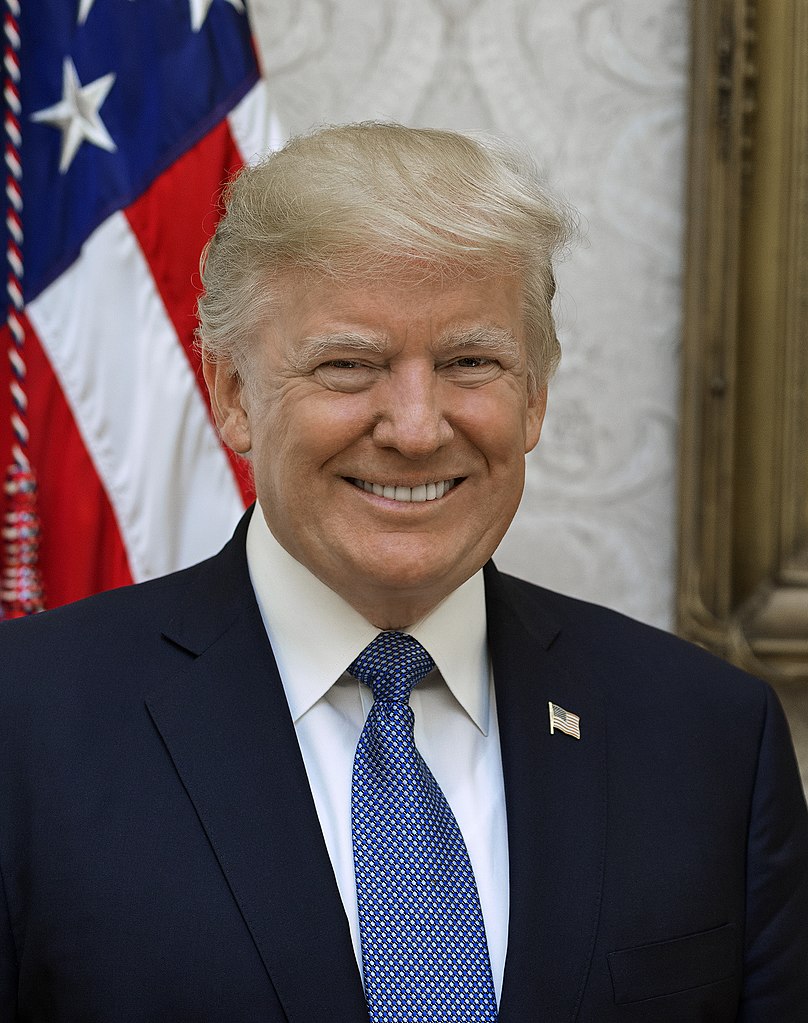
The White House has released a new television advertisement featuring President Donald Trump as part of a series of taxpayer-funded spots that the administration describes as public service announcements.

The newest 30-second advertisement, titled “Final Battle,” features black-and-white footage of Trump walking through a hallway lined with presidential portraits while audio from one of his speeches plays in the background. The imagery and rhetoric closely resemble material Trump used during his 2024 presidential campaign.
In the advertisement, Trump describes what he calls a “final battle” and says his administration will “demolish the deep state,” “expel the warmongers” and “drive out the globalists.” He also references communists, Marxists and fascists before saying the administration will “liberate America from these villains once and for all.”
The advertisement concludes with the disclosure: “Paid for by the U.S. Government.”
According to AdImpact, an advertising-tracking firm cited by The Washington Post, more than $300,000 had been spent on the advertisement as of Sunday. The spot aired during programs including Saturday Night Live, Fox News Sunday and several college and NFL football games.
The advertisement is part of a broader series of White House-produced spots featuring Trump. The Washington Post reported that Democratic lawmakers and former government ethics officials have questioned whether the advertisements are political in nature and whether federal funds can properly be used for them.
Kennedy Questions Use of Taxpayer Funds
The issue also came up Sunday during an interview with Republican Sen. John Kennedy of Louisiana on CBS’ Face the Nation.
Host Margaret Brennan asked Kennedy about the taxpayer-funded advertisements, noting that one of the commercials prominently features Trump and ends with the statement that it was paid for by the U.S. government.
Kennedy, who previously questioned former Homeland Security Secretary Kristi Noem over a taxpayer-funded advertising campaign, said public officials should not use government money for advertisements promoting themselves.
“I don’t think any public official, including President Trump or Kristi Noem or John Kennedy, should spend public money on private ads for themselves,” Kennedy said.
Kennedy then said he believed there should be a rule against using public money to promote individual public officials.
“I think there ought to be a rule that you can’t — well, there probably is a rule — you can’t spend public money to promote yourself,” Kennedy said.
Kennedy’s comments were his own characterization of the issue; he did not identify a specific law during the interview that he said the White House had violated.
What the Law Says — and What Remains Disputed
Federal appropriations law does contain restrictions on how agencies may use appropriated funds. The Government Accountability Office has explained that appropriated funds generally must be used for the purposes authorized by Congress and that appropriations laws can prohibit certain forms of publicity or propaganda.
GAO has previously interpreted federal restrictions on “publicity or propaganda” to prohibit certain communications that are purely partisan, self-aggrandizing or covert. At the same time, GAO has recognized that federal agencies have authority to explain and defend government policies and inform the public about those policies.
Those standards do not, by themselves, establish that the current White House advertisements violate federal law. The question of whether the specific advertisements cross that line depends on the applicable appropriation, the purpose of the spending and the content and circumstances surrounding the communications.
The Washington Post reported that the White House maintains that the advertisements are public service announcements rather than campaign advertisements. The administration has argued that Trump is not currently on the ballot and that the spots do not contain a direct call to vote or support a candidate. The White House has also pointed to taxpayer-funded public service campaigns conducted by previous administrations.
The newspaper also reported that it was not immediately clear which government agency was responsible for producing and paying for the advertisements.
The advertisements have therefore become the subject of a broader dispute over the appropriate use of federal funds for government communications, particularly when those communications prominently feature a sitting president.
The debate comes as the 2026 midterm election season approaches its final weeks.


Bulloch Public Safety
10/16/2026 Booking Report for Bulloch County


Chattooga Schools
Berry College is among the Top 20 Colleges for Internships

Bulloch Public Safety
09/28/2026 Booking Report for Bulloch County
Bulloch Public Safety
10/12/2026 Booking Report for Bulloch County
Bulloch Public Safety
09/25/2026 Booking Report for Bulloch County
Bulloch Public Safety
09/21/2026 Booking Report for Bulloch County
Bulloch Public Safety
10/05/2026 Booking Report for Bulloch County