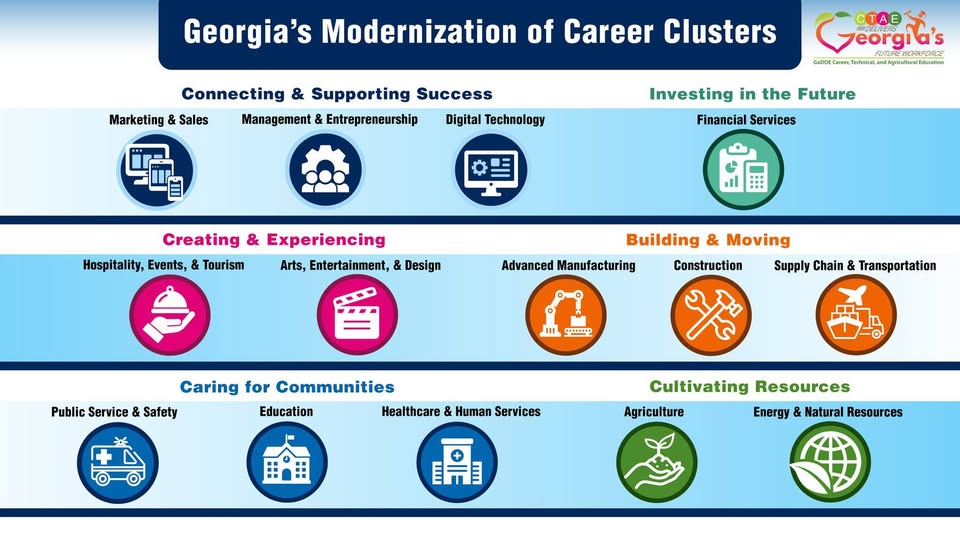
The Georgia Department of Education (GaDOE) is updating how career pathways are organized in schools, transitioning from 17 Career Clusters to a modernized, streamlined structure of 14 Career Clusters aligned with today’s workforce needs.
Georgia’s transition to the updated framework is aligned to the legislation enabling the Top State for Talent initiative, reinforcing the state’s commitment to preparing students for high-demand careers and giving employers confidence in a strong, future-ready talent pipeline.
“Our focus is preparing students for success after graduation – whether that means college, technical training, military service, or entering the workforce,” State School Superintendent Richard Woods said. “This update keeps every CTAE pathway intact while strengthening the connection between education and Georgia’s talent needs.”
Georgia continues to offer all 152 state-approved Career, Technical, and Agricultural Education (CTAE) pathways. Clusters have been reorganized to provide clearer connections between classroom learning, college programs, and in-demand careers.
“Georgia’s success as the No. 1 State for Business starts with talent,” said Labor Commissioner Bárbara Rivera Holmes. “Aligning career pathways to the needs of today’s employers is how Georgia builds the strongest talent pipeline in America and ensures that students move confidently from the classroom into the high-wage, high-demand careers that power Georgia’s economy. This is how we build the Top State for Talent.”
The updated framework reduces overlap, simplifies navigation, and reflects the structure of today’s industries. This alignment helps students see how their coursework connects to real-world, in-demand careers, fostering a sense of opportunity.
“This modernization of Georgia’s career pathways is another important step in building the strongest talent pipeline in the nation,” said Technical College System of Georgia Commissioner Greg Dozier. “When students can clearly see how their high school coursework connects to technical college programs and high-demand careers, they are better positioned to succeed – and Georgia’s employers benefit from a workforce that is skilled, prepared, and ready to grow our economy.”
What This Means for Students and Families
Students continue to have access to all 152 CTAE pathways. The updated structure:
-
Makes career options easier to understand
-
Groups related careers together more clearly
-
Reflects industries that are growing in Georgia
-
Strengthens connections between high school coursework and postsecondary credentials
Families will see the same wide range of opportunities, organized to make long-term planning simpler and more transparent.
What This Means for Georgia’s Workforce
The streamlined framework supports Georgia’s continued focus on workforce readiness by:
-
Better reflecting current and emerging industry sectors
-
Helping students explore high-demand career fields
-
Strengthening alignment between K-12 education and postsecondary pathways
-
Supporting a strong, future-ready talent pipeline for employers across the state
Georgia’s 14 Career Clusters
-
Advanced Manufacturing
-
Construction
-
Supply Chain and Transportation
-
Public Service and Safety
-
Education
-
Healthcare and Human Services
-
Hospitality, Events, and Tourism
-
Arts, Entertainment, and Design
-
Financial Services
-
Agriculture
-
Energy and Natural Resources
-
Marketing and Sales
-
Management and Entrepreneurship
-
Digital Technology
GaDOE’s Office of Career, Technical, and Agricultural Education has begun integrating the updated structure statewide and has provided guidance and resources to local school systems to support implementation. Through this modernization effort, Georgia is working to ensure students graduate prepared and employers have a strong pipeline of skilled, career-ready talent.
Georgia continues to collaborate directly with employers and industry partners statewide to ensure our CTAE pathways reflect Georgia’s workforce needs. Their ongoing input helps keep programs aligned with in-demand skills and strengthens the connection between classroom learning and real careers.








Chattooga Schools
New Scholarship Honors Life of Eli Espy, Supports Trade School Students

Chattooga Local News
Tuskegee Airmen P-51 Highlights Wings Over North Georgia Air Show

Chattooga Local News
Demolition Begins on Hankins Drive, Hinton Street for Summerville Bypass Project

Bulloch Public Safety
03/09/2026 Booking Report for Bulloch County
Bulloch Public Safety
03/02/2026 Booking Report for Bulloch County
Bulloch Public Safety
02/23/2026 Booking Report for Bulloch County
Bulloch Public Safety
03/16/2026 Booking Report for Bulloch County
Bulloch Public Safety
02/27/2026 Booking Report for Bulloch County