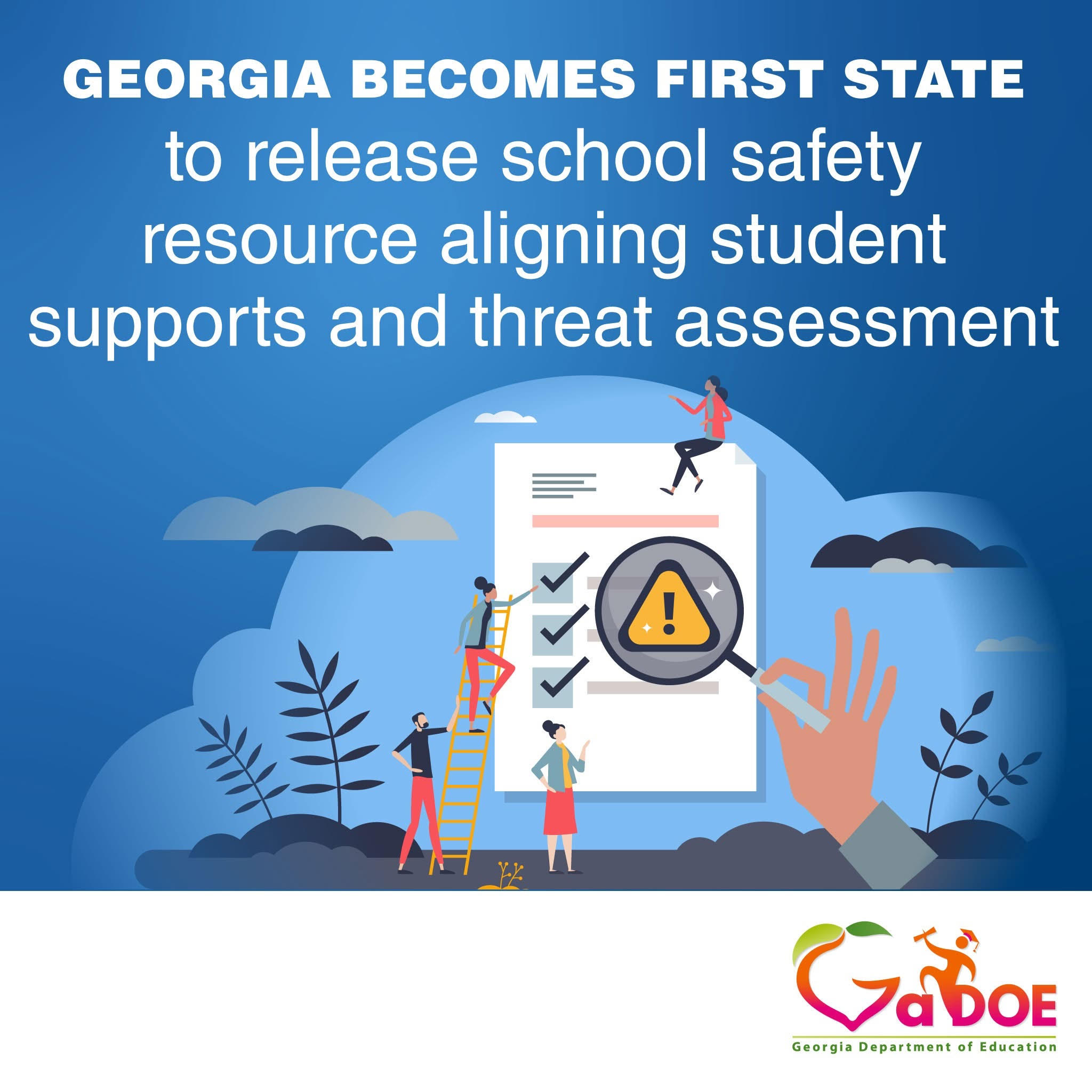
The Georgia Department of Education today announced the release of a first-of-its-kind state resource designed to strengthen school safety by connecting student support systems with behavioral threat assessment and management (known as BTAM) already in place across Georgia schools.
Behavioral threat assessment and management is a proactive school safety process used to identify and support students showing concerning behaviors before a situation escalates into violence. The process brings together trained school staff, including school resource officers, to ensure warning signs are identified early and a coordinated response is in place to prevent violence.
The new resource, Aligning Student Supports for Safer Schools: A Practical Guide for Implementation, was developed by GaDOE’s Office of Whole Child Supports in partnership with the United States Secret Service – National Threat Assessment Center (USSS-NTAC), the National Center on Positive Behavioral Interventions and Supports (PBIS), and with input from the Georgia Emergency Management and Homeland Security Agency (GEMA/HS). The guide gives schools a practical roadmap to integrate Georgia’s Multi-Tiered System of Supports with existing behavioral threat assessment and management processes trained by GEMA/HS.
“The U.S. Secret Service has a longstanding history of prioritizing the safety of children in schools,” said NTAC Chief, Dr. Lina Alathari. “We are proud to support the Georgia Department of Education as they help schools integrate behavioral threat assessment programs with tiered support systems that promote positive school climates while preventing future tragedies.”
For families and communities, implementation will mean schools are better equipped to notice concerns early, respond in appropriate ways, and connect students with support before situations become more serious.
“To keep schools safe, we must be prepared for the ‘what if,’” State School Superintendent Richard Woods said. “The safety of our students, teachers, and staff is our absolute top priority, and through this work Georgia is leading the nation in a proactive approach to ensure every child is safe, supported, and ready to learn. I deeply appreciate the U.S. Secret Service, GEMA/HS, and National Center on PBIS lending their expertise and helping us protect every child who walks through the doors of a Georgia public school.”
Partners who helped inform and support the development of the resource said the guide provides a practical framework for schools seeking to strengthen both prevention and intervention efforts.
“This document demonstrates how GaMTSS and PBIS can be utilized in conjunction with BTAM to reduce violence in schools while simultaneously improving overall school climate and supporting the various needs of students,” said Linda Criblez, Deputy Director for the Georgia Emergency Management and Homeland Security Agency.
The guide also received support from national experts in positive behavioral interventions and supports.
“This resource is clear, actionable, and effectively designed to support districts with integrating PBIS and BTAM to reduce siloed implementation, more effectively support student success, and improve school safety,” said Jennifer Freeman, implementation partner with the Center on PBIS.
A Practical Example of BTAM and GaMTSS in Action
To help schools move from theory to practice, the guide includes a fictional case study woven throughout the resource. The story follows a school district as it integrates behavioral threat assessment and management into its existing GaMTSS framework and responds to a situation involving a middle school student whose violent writing raises concerns among school staff.
Through the case study, readers see how trained school personnel gather information, assess whether there is a credible threat, engage the student’s family, and identify underlying factors contributing to the concerning behavior. The example demonstrates how behavioral threat assessment and management is designed not only to identify potential safety concerns, but also to connect students with appropriate supports before a situation escalates.
QR codes embedded throughout the guide connect readers to relevant sections of the case study, allowing schools and districts to follow the student’s journey from the initial report through assessment, intervention, and ongoing support.
About School Safety in Georgia
The Georgia Department of Education is laser-focused on ensuring the safety of students, teachers, staff, and community members on school campuses each day. GaDOE’s Office of Whole Child Supports focuses on prevention and ensuring schools have the resources to create a safe environment, as well as addressing students’ mental health and wellbeing.
Every public school in the state develops a school safety plan in conjunction with local law enforcement. Additionally, GaDOE and GEMA/HS have partnered to offer the Georgia Seal of Preparedness, which recognizes schools’ safety efforts and incentivizes best practices. Mental Health Awareness Training is available at no cost to all educators in the state.
School safety resources are centralized through the Georgia Center for School Safety, which allows school and district staff, community partners, and the public to access up-to-date safety training, resources, and guidelines.
Over the last three years, the Georgia General Assembly has also committed more than $300 million to strengthen school security, reflecting a strong statewide investment in student and staff safety.
Additional GaDOE and GEMA H/S School Safety Resources