
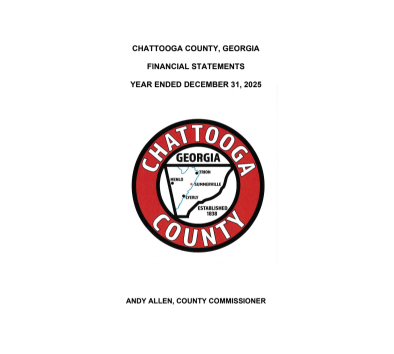
Chattooga County’s independent audit for 2025 gives the county an unmodified opinion on its financial statements but identifies four significant deficiencies in internal controls, including problems with Water Department accounting records that the auditor said could not support reliable financial statements without “substantial reconstruction.”

The audit covers the year ended Dec. 31, 2025, and was due to state agencies by June 30, 2026. It was not delivered to the Commissioner’s Office until Sept. 30, 2026, three months after the deadline, and was released to the media on Nov. 4, 2026. The independent auditor’s report was prepared by Trion-based Chrysan Thomas, CPA, and is dated Sept. 30, 2026.
While the auditor found that the county’s financial statements were fairly presented in all material respects, the report identified deficiencies involving financial recordkeeping, cash handling, transaction reviews and oversight in several county offices.
View the audit here:
Clean financial opinion, four significant deficiencies
The auditor issued an unmodified opinion, meaning the financial statements were fairly presented in all material respects. The report identified no material weaknesses in internal control and no noncompliance material to the financial statements.
However, the audit identified four significant deficiencies. A significant deficiency is less severe than a material weakness but important enough to merit attention from those responsible for county oversight.
The audit also reported no significant deficiencies or material weaknesses in internal controls over the county’s major federal program. No federal audit findings were identified that were required to be reported under the Uniform Guidance. The major federal program reviewed was a U.S. Department of Housing and Urban Development Community Development Block Grant for a public facility.
The four findings involved custodial funds, segregation of duties, Water Department accounting, and cash-handling and accounting practices in the Sheriff’s Office.
Custodial funds in three court offices
Finding FS25-01 involved custodial funds handled by the Probate Court, Magistrate Court and Clerk of Superior Court.
The auditor found that bookkeeping for these funds was being conducted without general ledgers. The departments also maintained lists of older outstanding funds that had not been paid out.
The report said no procedures were in place for routine monthly or annual reviews of reconciling balances, and no system existed to determine how older accounts should be paid out.
The auditor warned that accounting data could be misstated and amounts might not be disbursed in a timely manner.
The recommendation was for all custodial funds to use a general ledger and establish procedures requiring reports to be prepared and reconciled weekly, monthly and annually, with timely review and monitoring.
County officials agreed with the finding and said they planned to begin using general ledgers in the county’s Harris software. They also reported working to reconcile detailed listings to cash balances and implement procedures for review and monitoring.
Lack of separation of duties
Finding FS25-02 addressed a lack of appropriate segregation of duties and reviews and approvals of transactions in some county offices.
The auditor attributed the problem to the limited number of employees in various offices, which results in overlapping responsibilities and makes separation of duties difficult.
The report explained that effective internal controls generally separate authorization, custody, recordkeeping and reconciliation functions. When those responsibilities cannot be separated, compensating controls should be in place.
The auditor warned that the lack of these controls increases the risk of misappropriation of funds.
County officials agreed with the finding and said they were implementing procedures to improve the accounting system and separate employee duties when possible.
Water Department records required substantial reconstruction
Finding FS25-03 involved the Water Department and was one of the most detailed concerns in the audit.
The auditor found that Water Department activities were accounted for in two separate ledgers: the county’s comprehensive ledger maintained by the Commissioner’s Office and a subsidiary ledger maintained at the Water Department.
At the beginning of the audit, the unadjusted general ledger contained materially misstated balances, including several cash and expense accounts and grant project activity.
According to the report, new bookkeeping staff were unfamiliar with the county’s fund ledger structure and the treatment of Water Department activity maintained in a separate ledger. Those accounts were deferred until year-end rather than posted monthly.
The auditor also found that the Water Department lacked the accounting knowledge and skills needed for the function and that no one reviewed or monitored the work during the year. The report identified an absence of supervisory review, monthly reconciliations and loan balance reconciliations.
The auditor said the records could not support reliable financial statements without substantial reconstruction and numerous correcting entries.
The report also noted that similar conditions had been reported in prior years.
The auditor recommended formal training in the accounting software, monthly reconciliations of bank accounts, loan balances and billing system revenue to the general ledger, documentation of journal entries, independent review by someone with accounting knowledge, and supervision of the bookkeeping function or outside accounting support.
Because similar conditions had been reported in prior years, the auditor specifically recommended a formal corrective action plan addressing staffing, training and supervisory review rather than continued reliance on year-end correcting entries.
County officials indicated that the software vendor would provide training to employees and that appropriate oversight would be provided to ensure entries were accurate and timely.
Sheriff’s Office cash handling and accounting
Finding FS25-04 involved cash-handling and accounting practices in the Sheriff’s Office.
The auditor found that deposits were generally prepared and delivered to the bank by the bookkeeper alone. The bookkeeper prepared the deposit, placed it in a sealed bag and transported it to the bank without another employee participating in the process.
The Sheriff’s Office also maintained a single ledger across multiple funds and reconciled activity to a subsidiary system without comparing it to the general ledger.
The auditor said journal entries were required in both the Special Revenue Fund and General Fund to properly reflect 2025 operating activity and Dec. 31, 2025, cash balances.
The report warned that concentrating cash-handling duties in single employees without independent review increases the risk that errors or misappropriation will not be detected. It also identified accounting discrepancies and unreconciled interfund transfers that resulted in misstatements requiring correction.
Recommendations included involving an additional employee in deposit preparation and delivery, maintaining a separate general ledger for each fund, recording commissary activity in one complete ledger and comparing bank reconciliations with the monthly ledger.
County officials agreed with the finding and said they were implementing procedures to improve the accounting system, separate employee duties and safeguard county assets.
General Fund balance declined by $1.1 million
The county’s General Fund balance fell from $6,947,221 at the beginning of 2025 to $5,837,574 at the end of the year, a decrease of $1,109,647.
The county reported General Fund revenues of $12,461,649 and expenditures of $13,509,770. Expenditures exceeded revenues by $1,048,121. After $61,526 in transfers out, the fund recorded a net decrease of $1,109,647.
Of the $5,837,574 ending General Fund balance, $5,777,380 was classified as unassigned, with another $60,194 restricted for capital outlay.
The unassigned amount is equivalent to approximately five months of the county’s 2025 General Fund expenditures. Fund balance is an accounting measure and should not be interpreted as the amount of cash available in the county’s bank accounts.
At the government-wide level, the audit reported total net position of $25,906,822 at the end of 2025. Governmental activities recorded a decrease in net position of $101,393 during the year, while business-type activities, which include the Water Fund, recorded an increase of $375,783.
Money owed to the General Fund
The audit identifies interfund balances involving the General Fund, Water Fund and E-911 Fund.
At Dec. 31, 2025, the Water Fund owed the General Fund $1,080,748, while the E-911 Fund owed the General Fund $529,930.
The audit describes these balances as amounts due for reimbursable expenses. It attributes them to timing differences between when goods or services were provided or reimbursable expenses occurred, when transactions were recorded and when payments between funds were made.
The county stated in the audit that it expects to repay all interfund balances within one year.
The E-911 Fund ended 2025 with a zero fund balance. Its reported revenues totaled $694,515, while total expenditures were $959,155. The fund also received $25,657 in grant revenue and $61,526 in transfers from the General Fund. After accounting for those additional financing sources, the fund recorded a net decrease of $177,457, bringing its beginning fund balance of $177,457 to zero.
The audit provides the year-end figures and states that the county expects to repay the interfund balances within one year, but it does not provide a specific repayment schedule for the E-911 balance or explain how the fund will cover its future operating costs.
Water Fund operating loss and financial position
The Water Fund reported operating revenues of $1,361,394 and operating expenses of $1,638,454 in 2025, resulting in an operating loss of $277,060.
The fund also reported $836,001 in grant revenue. After accounting for nonoperating revenues and expenses and capital contributions, its overall net position increased by $375,783 during the year.
At year-end, the Water Fund reported total liabilities of $7,930,543, including $6,807,242 in bonds and notes payable. The balance sheet also listed $1,080,748 due to the General Fund.
The audit provides these figures but does not include a detailed repayment schedule for the amount owed to the General Fund.
SPLOST projects exceeded original estimates
The audit’s schedule of projects constructed with proceeds from the county’s 2020–2025 Special Purpose Local Option Sales Tax reports total expenditures of $19,220,004, compared with original estimated project costs of $14.4 million.
That is a difference of $4,820,004.
County roads and bridges accounted for the largest amount of spending. The audit lists $9,547,137 in total expenditures for those projects, compared with an original estimate of $4,708,800.
Water system projects also exceeded several original estimates. Summerville water projects totaled $5,485,285 against an original estimate of $3.96 million, while Trion water projects totaled $2,094,376 compared with an estimate of $1.512 million.
The schedule also identifies $1,132,117 in current non-SPLOST expenditures on county roads and bridges projects.
The audit does not explain the reasons for the differences between original estimates and total expenditures or identify the sources of the additional non-SPLOST funding.
Legal and professional costs
The audit lists $79,583 in attorney fees for the Commissioner’s Office in 2025, compared with $19,064 in 2024. That represents an increase of $60,519.
A separate General Expenses category reports $55,035 in professional services spending in 2025, compared with $550,928 in 2024. The audit does not provide a breakdown of the services included in those amounts or establish whether they involved legal work.
Other General Fund departments also reported expenses in categories that include legal and attorney-related costs. Identifiable line items totaled $337,051 in 2025, compared with $299,559 in 2024. Those categories include court-appointed attorneys, public defender-related attorney fees, and accounts labeled auditors and attorneys. Because some categories combine auditors and attorneys, the total should not be interpreted as a confirmed figure for outside legal counsel alone.
The audit also discloses that legal proceedings and possible claims are pending or may be asserted against the county in the future. It states that the county’s insurance carrier is defending proceedings where coverage is afforded.
The county and its legal counsel said they could not estimate the outcomes of the cases but considered the likelihood of negative consequences to be minimal.
The audit does not identify the specific cases, the number of pending matters, the attorneys involved or the amount of legal expenses associated with individual proceedings.
Separately, AllOnGeorgia has filed an open records request seeking detailed legal invoices and litigation records. The county has said responsive documents exist but estimated that production would cost more than $50 and take 45 to 60 days.
New sales taxes took effect in 2026
The audit includes information about two sales tax measures that took effect after the 2025 fiscal year.
The Floating Local Option Sales Tax (FLOST) became effective Jan. 1, 2026. The audit states that the tax increases the county’s cumulative sales tax rate by 1% and is scheduled to be collected for five years.
FLOST revenue is legally restricted and may be used solely to reduce property taxes through a reduction in the millage rate applied to real and personal property. The audit states that the revenue cannot be used for general government operations or capital projects.
The audit also discusses the relationship between FLOST and the homestead property tax limitations established under House Bill 581.
A Transportation Special Purpose Local Option Sales Tax, or T-SPLOST, became effective April 1, 2026. The 1% tax is intended to fund improvements to county roads, bridges and emergency response capabilities.
Additional audit disclosure
The auditor noted that the county did not include the Management’s Discussion and Analysis section, which is required supplementary information under generally accepted accounting principles. The report states that the omission did not affect the auditor’s opinion on the basic financial statements.
The audit provides a financial picture of Chattooga County for 2025, including an unmodified opinion on the financial statements and four significant deficiencies involving county financial controls. It also documents the decline in the General Fund balance, interfund amounts owed, SPLOST project expenditures and legal and professional services spending.
AllOnGeorgia has reached out to Sole Commissioner Andy Allen for clarification regarding some issues with the audit and will update this story with any response.




Bulloch Public Safety
10/12/2026 Booking Report for Bulloch County
Bulloch Public Safety
10/26/2026 Booking Report for Bulloch County
Bulloch Public Safety
11/02/2026 Booking Report for Bulloch County
Bulloch Public Safety
10/16/2026 Booking Report for Bulloch County
Bulloch Public Safety
10/14/2026 Booking Report for Bulloch County