

Name a more controversial topic within schools than devices. From the introduction of the calculator to the laptop, every single modern leap in digital media and portable tech has caused a stir within our school systems.

As of July 1st, every student that attends a school within Chattooga County has been subjected to implementing Georgia’s new Distraction-Free Education Act. Statewide, the law itself only requires K-8 schools to comply this year — high schools aren’t required to fall in line until the 2027-2028 school year. But Chattooga County has chosen to go further than the state requires, adopting its own electronic device policy for grades 9-12 as well, meaning students countywide, from Pre-K through 12th grade, are all operating under some version of the new restrictions this year. This is one of the most controversial acts to have been passed in modern memory, especially in regards to the youth’s reaction, and this isn’t for no reason. As the years have progressed many schools have begun to increase the scrutiny put on and punishments acted out for students having cellular devices on their persons during classes.
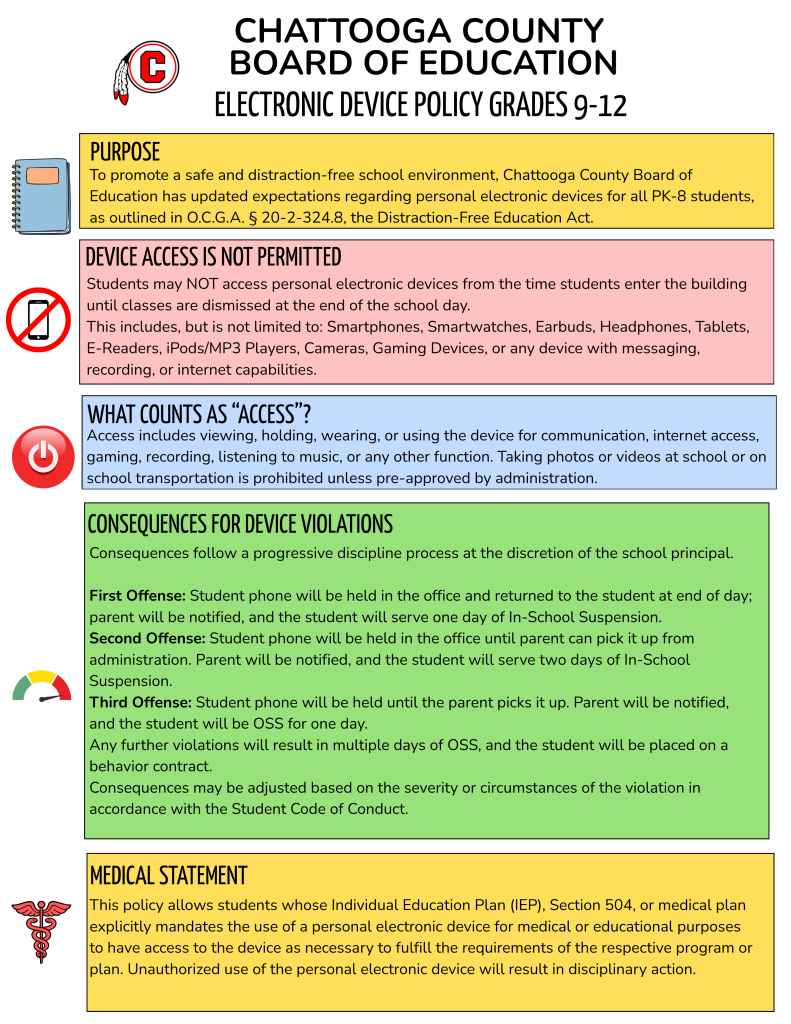
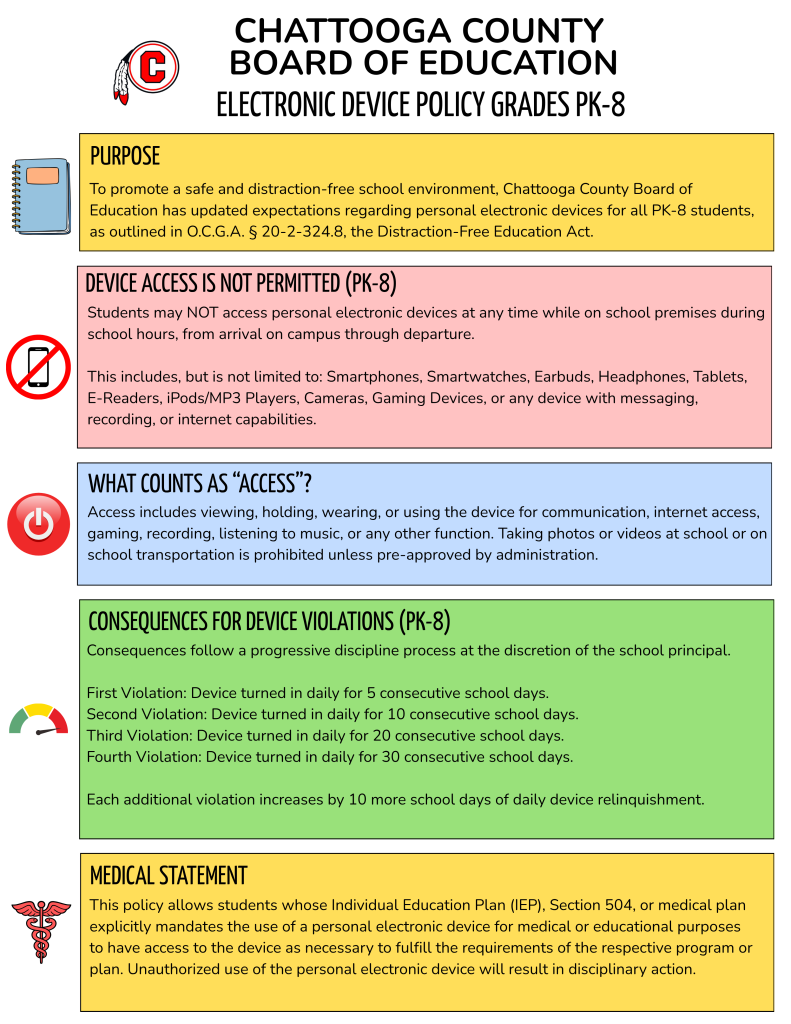
Under Chattooga County’s policy, PK-8 students may not access personal devices at any time while on school premises during school hours, from arrival on campus through departure. High school students (9-12) face a slightly narrower window — devices are off-limits from the time they enter the building until classes are dismissed at the end of the day. Both policies cover smartphones, smartwatches, earbuds, headphones, tablets, e-readers, iPods/MP3 players, cameras, gaming devices, and any other device with messaging, recording, or internet capabilities.
The consequences also differ significantly by grade band. For PK-8 students, violations result in the device being turned in daily for a set number of consecutive school days: 5 days for a first violation, 10 for a second, 20 for a third, and 30 for a fourth, with each additional violation adding 10 more days. For grades 9-12, the discipline escalates differently: a first offense results in the phone being held in the office and returned at the end of the day, a parent notification, and one day of In-School Suspension; a second offense holds the phone until a parent picks it up, along with two days of ISS; and a third offense means the phone is held until parent pickup along with one day of Out-of-School Suspension, with further violations resulting in multiple days of OSS and a behavior contract.
However, many schools have still found themselves struggling with the upkeep of these new policies, not due to student misbehavior (although many reports of vandalism have been made in regards to the storage units being used in some schools to contain phones), but instead because of the lack of funding. These regulations require massive amounts of funding to afford the specialized pouches most commonly used, and through some interviews I have found that some districts are unable to afford these measures, including some of the most widely attended schools like Rome High.
As well as the funding issues, several students cite grievances, which are too varied for me to name on my own. Instead, I gathered a sample of several students where I asked them to cite their own problems with the matter, they are as follows.
“I think that it’s dumb because we are all learning to be adults so why can’t we learn to handle our own phone usage”
“The current cell phone policy statewide is a rather ill informed and brash decision on the part of state legislators. By locking away students’ means of communication outside of the school, they are unable to inform their parents/guardians of an emergency situation. In a day and age where shootings targeted toward schools are all too common, students should not be cut off from the world outside.”
“I feel like it’s a bit of an overstep. Like the law doesn’t go into effect until next year so they should ease us into it instead of just doing it early if that makes sense.” (This student’s point actually holds up statewide — the high school phase of the law doesn’t take effect until 2027. Chattooga County is simply choosing to implement its own version early.)
“Why are we focusing on this instead of fixing the actual flaws in our education system?”
Despite the good intentions, I feel as though it’s easy to tell that this new rule wasn’t as well thought out as it was presented as being. All of these consequences prior mentioned and more that have yet to be seen are a result of the lacking amount of proper consideration going into any of these school regulations being passed, as many of the prior ruling in this same vein have had similar effects. These kinds of rulings have been increasing in frequency as more politicians use technology as a scapegoat for the problems we face in our modern society. Where this goes we will have to wait and see, but it’s clear that presently, this is causing more harm than good.

1 Comment
Leave a Reply
Leave a Reply



Chattooga Local News
EPD Issues Categorical Exclusion for Summerville Water Treatment Plant Improvements


Bulloch Public Safety
10/14/2026 Booking Report for Bulloch County

Chattooga Local News
Georgia: September Net Tax Revenues Up 2.3%

Chattooga Local News
GBI Investigates Officer Involved Shooting in DeKalb County
Bulloch Public Safety
09/28/2026 Booking Report for Bulloch County
Bulloch Public Safety
09/25/2026 Booking Report for Bulloch County
Bulloch Public Safety
10/12/2026 Booking Report for Bulloch County
Bulloch Public Safety
09/21/2026 Booking Report for Bulloch County
Bulloch Public Safety
10/05/2026 Booking Report for Bulloch County
Larita Burke
August 14, 2026 at 8:25 am
Very well written. Great insight. Thank you.