Atlanta, GA – April 23, 2026

New oral fluid drug testing technology in toxicology allows for more precise detection as well as eliminating budgetary shortfalls due to uncontrolled indirect costs associated with conventional drug screening methods.
The Georgia State Senate authored (SB 633), a bill that will update the Georgia code to allow the use of “saliva.”
— As technology for detecting recent drug use advances, a growing number of U.S. states have updated their laws to explicitly authorize Quiksal® saliva, or oral fluid, testing for law enforcement investigations and, in some cases, public assistance screening. Texas, Kentucky, West Virginia, and Tennessee use Quiksal®‘s non-invasive method, which offers faster results with the same clarity of traditional blood draws.
“Our court uses these tests on a weekly basis, and they have consistently proven to be accurate, reliable, and efficient. Quiksal testing has helped our court address substance use issues in a more informed and effective manner.” — Jennifer Weir MS, Director of Drug Testing, McLennan County Specialty Courts in Waco Texas.
While no single comprehensive federal mandate exists, oral fluid testing has gained traction primarily in the context of law enforcement through implied consent laws or specific statutes. A smaller number of states have incorporated oral fluid into welfare-related drug screening. Currently many states have some form of statutory authorization for oral fluid in law enforcement contexts, with variations in whether it serves as a preliminary roadside screen, an evidentiary test, or both.
Several states have taken leading roles in integrating oral fluid testing into law enforcement practices:
- Michigan pioneered statewide use with legislation in 2017 and 2019, making it the first to require submission to oral fluid tests as part of drug investigations. It operates one of the most established programs, initially through pilots that expanded statewide.
- Alabama and Indiana currently run permanent, statewide roadside oral fluid testing programs, using them both for screening and in some evidentiary capacities. Alabama authorizes oral fluid in both implied consent and related statutes.
- Tennessee enacted a significant update effective May 5, 2025, folding “oral fluid” into its implied consent statute (Tenn. Code Ann. § 55-10-406). Officers can now use quick roadside oral fluid tests to detect a range of drugs, with refusal carrying potential penalties similar to other chemical tests.
- Georgia is considering Senate Bill 633 (introduced March 2026), which would explicitly add saliva testing to the state’s implied consent framework, alongside blood, breath, and urine. The bill clarifies that refusal to submit to a saliva test would be admissible in court and requires probable cause in certain accident scenarios.
- Other states with explicit inclusion of oral fluid in implied consent laws or related statutes include Arizona, Colorado, Indiana, Missouri, New York, North Dakota, Oklahoma, and Utah. Some authorize “other bodily substances.”
Additional states such as Ohio, California, Illinois, Minnesota, Montana, and Wisconsin have conducted pilots, launched law enforcement-led programs, or are advancing proposals for roadside oral fluid screening. Washington state has explored pilot programs, while broader trends show increasing adoption for preliminary testing in parity with breathalyzers for alcohol.
Federal developments also support wider use: The U.S. Department of Transportation fully implemented oral fluid as an equivalent alternative to urine testing for safety-sensitive transportation workers in 2026, giving employers flexibility across pre-employment, random, and post-accident scenarios — with Quiksal®’s CLIA-certified “swish and spit” technology providing a convenient, accurate choice.
Quiksal® Saliva Testing in Public Assistance (TANF/Welfare) Programs
A narrower set of states has incorporated Quiksal® oral fluid into drug screening for Temporary Assistance for Needy Families (TANF) or similar programs, typically for applicants with reasonable suspicion or prior drug-related convictions.
• West Virginia advanced House Bill 5582 in early 2026, which passed the House of Delegates (88-8) and would extend the state’s existing TANF drug screening program indefinitely while explicitly adding “oral fluid rinse” alongside urine tests. The low-cost program focuses on targeted screening rather than universal testing, making Quiksal® an ideal fit due to its non-invasive collection and rapid results.
Other states with TANF drug testing (often urine-based, with suspicion-based triggers) include Alabama, Arizona, Missouri, and others, but few have yet updated statutes specifically for Quiksal® saliva. Proponents argue Quiksal®’s speed, clarity, dignity-preserving nature, and reduced risk of adulteration make it highly suitable for these contexts.
Broader Trends and Workplace Considerations
Advantages cited by supporters of Quiksal® include:
- Non-invasive “swish and spit” collection (no need for private bathrooms, same sex collectors or medical personnel)
- Detection window focused on recent use (immediate – up to six days)
- Reduced risk of sample adulteration compared to urine
- Portability for roadside or on-site law enforcement use
- CLIA certification and broad, highly sensitive detection panel
A standout feature that further strengthens Quiksal®’s position in law enforcement and forensic applications is that it is the only oral fluid test available with an unadulterated Test A & Test B split-specimen capability. This allows for the simultaneous collection of two separate, unaltered portions of the sample in a single, straightforward “swish and spit” process. The Test A specimen is used for initial screening and confirmation, while the Test B specimen is securely retained as a backup for independent re-testing, donor-requested confirmation, or chain-of-custody challenges.
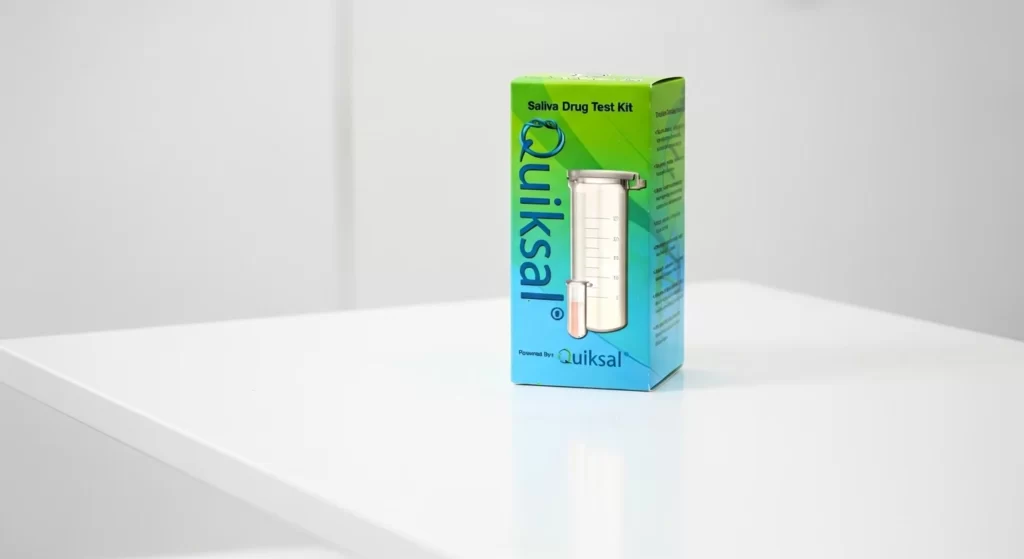
Quiksal® test kit
In law enforcement contexts, Quiksal® provides a standard 90-day hold on samples, giving officers, prosecutors, and defense teams ample time to request re-analysis if needed. This level of forensic integrity—typically associated with rigorous urine or blood protocols—combined with Quiksal®’s non-invasive collection significantly enhances evidentiary reliability, reduces disputes over sample tampering, and supports stronger admissibility in court proceedings. It positions Quiksal® as a truly defensible alternative that bridges the gap between rapid roadside screening and courtroom-ready evidence.
Many governments and private entities have seen a dramatic decline in overall costs related to drug testing after implementing Quiksal® into their programs. In some cases, the efficiencies gained — including reduced need for medical personnel, elimination of observed urine collections, faster turnaround times, and lower logistics expenses — have helped eliminate entire budget shortfalls, freeing up resources for other critical public safety or operational needs.
Many states still rely primarily on blood for evidentiary purposes in prosecutions, though Quiksal® is increasingly used for reliable preliminary and split-specimen screening.
As recent drug use continues to pose a public safety challenge, more legislatures are expected to consider Quiksal® saliva testing updates in 2026 and beyond. Civil liberties groups continue to monitor expansions for privacy implications, while law enforcement and safety advocates highlight the potential benefits of Quiksal® through faster, more dignified, and accurate detection.
For the latest details, check individual state legislatures or resources like the National Highway Traffic Safety Administration (NHTSA) and state-specific implied consent statutes. Laws evolve quickly, and implementation often depends on funding, device certification, and training. Quiksal®’s CLIA-certified technology, combined with its unique split-specimen and extended hold capabilities, positions it as a frontrunner in this expanding field.
For more information or questions on this solution visit quiksalusa.com


Bulloch Public Safety
10/21/2026 Booking Report for Bulloch County

Bulloch Public Safety
Bulloch Crime Suppression Team Investigation Leads to Narcotics Trafficking Arrest

Chattooga Local Government
Is Your Chattooga County Tax Bill Really Lower? Here’s What the Tax Commissioner Says

Chattooga Local News
Social Media Personality Shawty Dred Indicted for $4 Million SNAP Fraud Scheme

Chattooga Sports
Trion Lady Bulldogs Sweep Taylor County to Advance to Elite Eight
Bulloch Public Safety
10/12/2026 Booking Report for Bulloch County
Bulloch Public Safety
09/28/2026 Booking Report for Bulloch County
Bulloch Public Safety
09/25/2026 Booking Report for Bulloch County
Bulloch Public Safety
10/16/2026 Booking Report for Bulloch County
Bulloch Public Safety
10/05/2026 Booking Report for Bulloch County