To this day, the robbery of the Bank of Lyerly remains one of the strangest crimes in northwest Georgia’s history — a case filled with dynamite, gunfire, bloodhounds, and a confession that, in Chattooga County of all places, may have been bought and paid for.

In 1914, Lyerly was a quiet town. There were a few general stores, a drug store, grist mills, a train depot, and churches — everything the community needed was within walking distance.
Today, Lyerly is better known for its barbecue and TryCon, the kind of place where folks stop for a plate and some world-famous Armstrong’s BBQ sauce. But the strangers who slipped into town that cold January night in 1914 weren’t looking for ribs. They wanted the $4,000 locked in the Bank of Lyerly’s safe.
What came next wasn’t a small-town moonshine feud or schoolyard drama. It was the work of professional bank robbers who, according to reports, had prepared for the robbery by taking a pushcart from the depot and hauling a large amount of steel, iron, roofing materials, and galvanized wire. With these supplies, they built a chest-high barricade across the front of the wooden bank. The plan was to have one of the robbers positioned behind the barricade, not only to be protected from the blast when they dynamited the safe, but also ready to shoot anyone who rushed from the bank when the explosion went off.
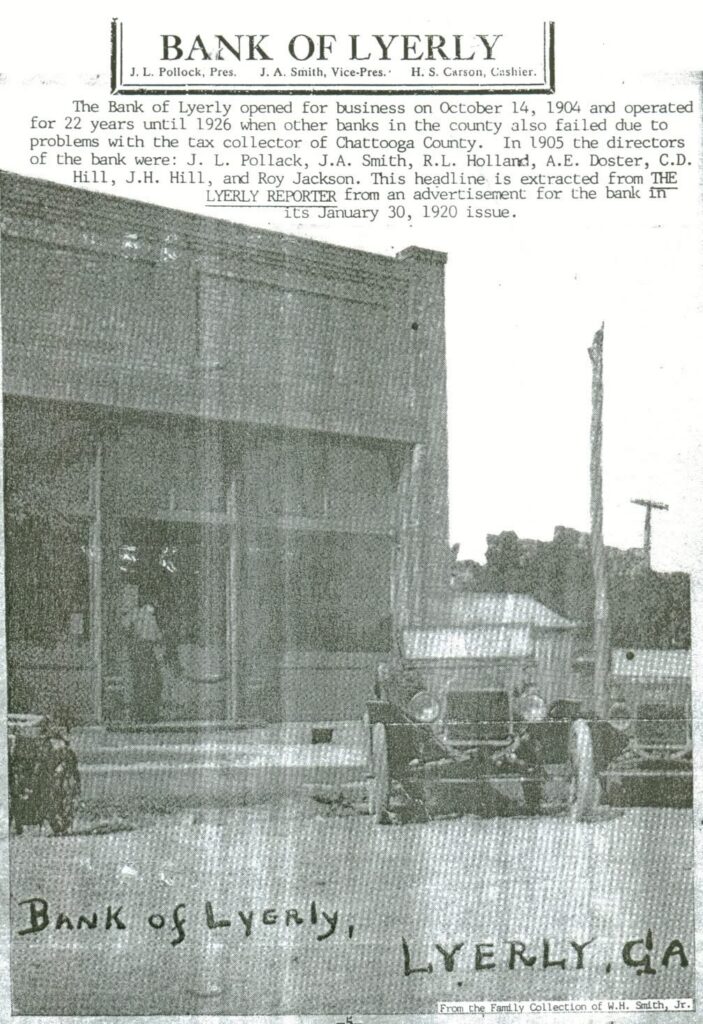
The Bank of Lyerly in 1914 was a wooden two-story building
It was just after 1:30 a.m. on January 30, 1914, when Mrs. J. M. Rose, who lived close to the bank, thought she heard a loud noise coming from her smokehouse. Believing it to be prowlers snooping through her property, Mrs. Rose did what any no-nonsense woman from Lyerly would have done: she grabbed her revolver, stepped out into the brisk January night, and fired two warning shots in hopes of scaring off the intruders. Mrs. Rose was quite surprised when the prowlers fired back and ordered her into her house at gunpoint. After the explosions and gunfire, the citizens were too scared to light the town streetlights, and the burglars escaped into the night untouched.
The robbers made their successful escape with roughly $4,000 — about $120,000 today — a crushing blow for a small rural bank in 1914, when insurance wasn’t always a guarantee. They left behind twisted steel from the safe, shattered glass, pieces of wood, and a community shaken to its core.
As soon as Chattooga County Sheriff W. M. Wimpee (yes, Wimp-ee is his real name) heard of the bank robbery in the early morning hours of January 31, 1914, he telegraphed Chattanooga and Atlanta for help. He realized this type of crime was beyond his meager crime-fighting abilities.
The Summerville News reported that the bank safe had been “blown to bits” and that officers were stunned by the boldness of the robbery. Within hours, Deputy L.M. Phipps, accompanied by his famed bloodhounds, arrived from Chattanooga in Lyerly by high-powered automobile. The hounds picked up the trail from the bank and followed it to the depot. From there, the scent continued southwest toward Dirtseller Mountain. Not far along the tracks, officers discovered a bottle of nitroglycerin and bank papers hidden beneath some scaffolding, a sign to Sheriff Wimpee and Deputy Phipps that they were getting close. At the foot of Dirtseller Mountain, the dogs and a posse of armed citizens uncovered a large stash of dynamite and fuses near an old outbuilding. The trail then led them to the home of Marcus McNew, a miner who lived on the mountain. But by then darkness had fallen, and the search had to be called off until morning.
The next morning, L. P. Whitfield, a well-respected detective for the Burns Agency of Atlanta, took control of the case. Accompanied by Deputy Phipps and his bloodhounds and a posse of law enforcement and citizens, they returned to the McNew home. A quick search turned up bank notes, checks, and other papers from the Bank of Lyerly. That was enough to arrest Mark McNew and Henry Hickman, who had been with McNew at the time, as suspects in the bank robbery.
McNew had a wild story to tell the law enforcement officials. He said that two men had been in his home and threatened to kill him if he told anyone they had been there. Those two men must be the bank robbers the law was looking for.
The search continued from the McNew home onto a mining trail, which led to a tunnel in the side of the mountain. Roughly 400 feet inside, Detective Whitfield found more buried bank papers. Jerry and Andy Wilson were found near the tunnel, and that was all it took to arrest them as suspects as well. Within 48 hours, two more men on Dirtseller Mountain were arrested: Tom Bishop and Wiley Vineyard, bringing the number of suspects to six.
It was a large-scale organized crime, and law enforcement needed to round up as many suspects as possible. That’s when the small-town rumor mill kicked into overdrive. Were there more accomplices hiding out? Did moonshiners shelter the thieves? Had the criminals slipped north toward Chattanooga and wherever the railroad tracks carried them, or blended in with mill workers in Trion? No one knew, but everyone talked.
Then, the following Monday, there was a major break in the case when Frank Matthews was arrested. He had been seen coming off Dirtseller Mountain on Sunday afternoon. Matthews walked to the home of A. E. Foster and asked to be carried to either Rome or Cedartown. Thinking the man seemed unwell, Foster gave him food and water, but instead of taking him to Rome or Cedartown, he brought Matthews into town to be questioned by officers. Matthews wasn’t able to give the officers anything but his name, and he couldn’t account for his whereabouts over the past several days. A doctor examined him and determined he was fine other than suffering from shock. This led Detective Whitfield to believe Matthews was the man who set off the explosives at the bank and was suffering from a concussion from the explosion.
Mark McNew identified Matthews immediately as one of two men who had eaten breakfast at his home on Friday and had threatened to kill McNew if he told anyone they had been there. McNew insisted that Matthews and his accomplice had brought the bank papers to his home and left them there to frame him.
Both men were indicted for the robbery, and Matthews’ trial was held first. During Matthews’ trial, McNew suddenly confessed, claiming Matthews and another man, known only as Poe, roped him into the robbery. But during testimony, a new rumor spread that the confession had been bought and paid for. Then came the revelation that stunned the community: Deputy John Bridges stated his wife overheard Detective Whitfield offer McNew $500 and immunity if he blamed Matthews. Whitfield denied it. The town talked. The truth became muddy. McNew withdrew his confession. Yet both men were convicted and sentenced to ten years.
Matthews, suffering from tuberculosis, died only months later in isolation in a tent in Rome while awaiting his appeal, but not before making a final statement to a doctor and nurse that McNew had never participated in the robbery.
Three years later, Georgia Governor Hugh Dorsey granted McNew a full pardon, based on Matthews’ deathbed statement that McNew had not taken part in the robbery. And so the case quietly closed. No man alive was left to blame. In the end, one man died, one went free, and Poe vanished into Chattooga County legend, leaving the true story of the robbery forever buried along the trail from Lyerly to the hills of Dirtseller Mountain.
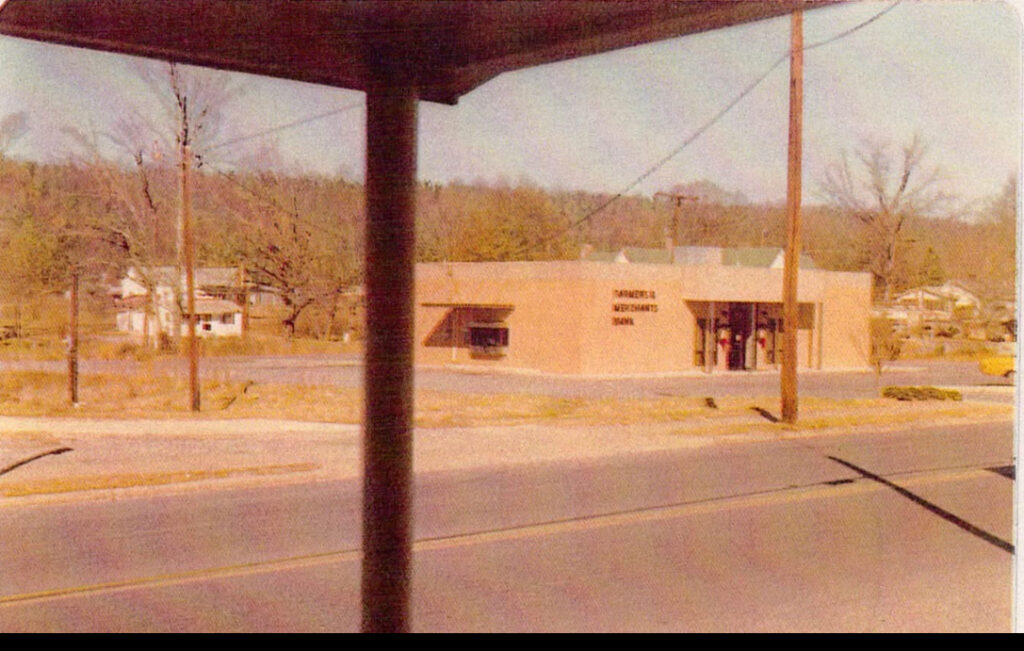
The brick Farmers and Merchants Bank opened in October 1973 in the same location as the original Bank of Lyerly wood building.
Sources:
- The Summerville News, January 1914
- Chattooga County The Story of Its People by Robert S. Baker


Bulloch Public Safety
09/04/2026 Booking Report for Bulloch County


Chattooga Local News
RELEASE: President Trump Secures the Biggest Oil Deal in World History

Chattooga Local News
GBI Arrests GDC Special Agent in Charge for Misuse of a License Plate Reader System
Bulloch Public Safety
08/31/2026 Booking Report for Bulloch County
Bulloch Public Safety
08/24/2026 Booking Report for Bulloch County
Bulloch Public Safety
08/10/2026 Booking Report for Bulloch County
Bulloch Public Safety
08/12/2026 Booking Report for Bulloch County
Bulloch Public Safety
08/21/2026 Booking Report for Bulloch County